Deriving safety
properties of critical software from the system risk analysis
J.L.
Boulanger ]F, V. Delebarre ] and S. Natkin ]F
]
CESIR, 124 rue Vieille du Temple 75003-Paris France
F CEDRIC/CNAM
292 rue Saint Martin 75141 Paris Cedex 03 France
Summary
Safety properties of critical software are consequences of
the application safety properties (i.e. the front collision of two trains must
not occur), and of the system design choices. This paper presents the first
results of a SNCF and CESIR join research project which purpose is to design a
constructive and formal method to derive, at each design level, the safety
properties of sub-systems from the System Preliminary Hazard Analysis. One of
the goals of this method is to obtain, at the lowest level, properties of the
safety software, which can be checked either by formal proof or by testing. The
method relies on two concepts: the safety kernel, proposed by J. Rushby, and a
generalization and formalization of the notion of "restrictivity",
used in classical safe hardware design. An application to MAGGALY ([MAIRE 93]),
the automatic pilot of Lyon unmanned Subway, is presented.
Summary................................................................................................................................................................................... 1
1. Introduction...................................................................................................................................................................... 3
1.1. Usual
Process for safety critical systems demonstration................................................................................. 3
1.2. Software
formal process for safety critical systems......................................................................................... 3
1.3. Formal
Methods for safety critical systems....................................................................................................... 4
1.4. Safety
Kernel........................................................................................................................................................... 4
2. Definitions......................................................................................................................................................................... 4
2.1. Safety
properties..................................................................................................................................................... 4
States, walks and Properties.......................................................................................................................................... 4
Undesired event............................................................................................................................................................... 4
Safe states......................................................................................................................................................................... 4
Passive safe state............................................................................................................................................................. 5
2.2. Safety
Kernel........................................................................................................................................................... 5
System organization....................................................................................................................................................... 5
System behavior.............................................................................................................................................................. 5
Safety based on the kernel design................................................................................................................................ 6
3. Case
Study........................................................................................................................................................................ 6
3.1. Case
Study description and objectives............................................................................................................... 6
3.2. System
breakdown................................................................................................................................................. 7
3.3. Safety
properties at the system level................................................................................................................... 8
3.4. Safety
properties allocation onto system components.................................................................................... 8
Restrictivity....................................................................................................................................................................... 9
Safety properties identification and allocation.......................................................................................................... 9
Interfaces properties..................................................................................................................................................... 11
Timing constraints......................................................................................................................................................... 11
Risk closure.................................................................................................................................................................... 11
4. Formal
Process for safety critical systems................................................................................................................ 12
References............................................................................................................................................................................... 14
1. Introduction
1.1. Usual Process for safety critical systems demonstration
In safety applications, safety demonstration relies on two
kinds of activities:
·
At the system specification level, risk
analysis is performed. Undesired events are identified by safety engineers and
the risk analysis checks that system specifications are robust enough to avoid
undesired events occurrence. A system safety framework describes the activities
to be performed throughout the life cycle.
·
Testing activities: dedicated system
engineers specify a testing strategy, which is «safety oriented» and a specific
team, performs testing tasks.
Once system level specifications and basic implementation
concepts have been "validated" by risk analysts, the development is
organized as for any other project. The safety testing strategy is destructive.
There is a discontinuity in the safety activity process, so those safety
objectives are not traceable easily. Also, the problem of testing completeness
and stopping is difficult.
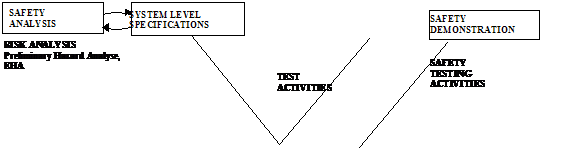
Fig.1: Classical life cycle.
1.2. Software formal process for safety critical systems
Considering the software life cycle (Fig.2), formal methods
enable to integrate validation and verification activities within the design
and development process. Refinement and proof control design and development
steps. As a consequence, safety properties are traceable if they have been
included in the formal model. The "missing link" of such an approach
takes place between system analysis, risk analysis on one hand, formal modeling
on the other hand. In fact, there is no traceability between safety objectives
at the system level and properties, which have been proved during the software
life cycle. As a consequence, there is no traceability between proven
properties and safety testing strategy.
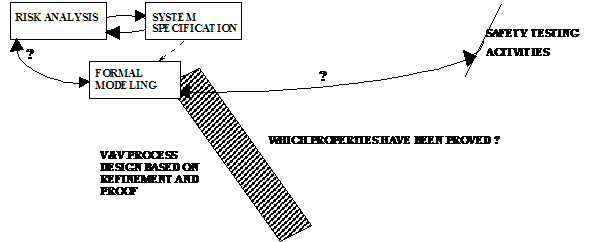
Fig.2:
Software formal process for safety critical system.
A classical distinction in system modeling is that between safety and liveness properties. A safety property stipulates that specific "bad things" do not happen during execution while a liveness property stipulates that certain "good things" do happen (eventually).
1.3. Formal Methods for safety critical systems
"A system
may be proved if and only if it has been designed to be proved". We think
that formal methods (either model checking methods or re-writing based methods)
are efficient and applicable for large safety critical systems if the system
design makes the system provable. The objective of this study is to define a
system design process, which includes the demonstration of safety property
achievement. It is a constructive approach based on the Safety Kernel Concept
([Rushby 89]).
1.4. Safety Kernel
In security
area, a security kernel is a set of components, whose correction properties ensure that security properties for the whole system are verified. In this
paper, we are to point out how this approach is applicable to safety critical
systems. Kernel based architectures are characterized by a set of second order
properties: " a Î op*, P(a). Such properties state that, whatever operations or events
(op*) which occur from the kernel environment, the systems properties are
verified.
Such an
approach implies the twofold design features:
·
The safety properties of the system
must be formalized in terms of kernel functions and related correction
properties.
·
No assumption is done for the system
components, which are not within the kernel.
2. Definitions
2.1. Safety properties
States, walks and Properties
The behavior of a system is the set of walks that it can
generate; a specification is likewise a set of walks. A property is a predicate
on walk.
Behaviors, specifications and properties should be prefixed
closed: if a given walk satisfies a specification, for example, so should all
its prefixes.
Undesired event
For operational phases of a system, the system behavior is
perceived as a safe behavior if undesirable events do not occur. Undesired
events may be identified in the early stages of system analysis through risk
analysis activities. It is based on system operational phases definition,
system basic principles and system level specification. On the basis of
undesired event identification, the set of safety properties (Pi) is defined:
"Pi: the undesired event Ei will never occur"
Safe states
The safety properties must be mapped onto the system behavior description. A random process on a state space S (discrete or continuous) may describe the system behavior. Let us note w = ((X1,t1),(X2,t2),…,(Xi,ti),…) a random walk in the states space, where Xi denotes the state which has been reached in i steps (transitions) and ti is the instant time when the system enters state Xi. The system behavior is safe if no walk contains a state where a safety property is not verified.
Transitions are controlled by three kinds of events:
·
Environment interactions (A is the set
of associated transitions).
·
Commands set by the control-command
subsystem (C is the set of associated transitions).
·
Recovery commands which can be set and
controlled either by an operator or by the control command subsystem (R is the
set of associated transitions).
A command c Î C is defined by
its local pre-conditions and post conditions. Pre-conditions are evaluated on
variables which are monitored and post conditions set control variables.
The system is in a safe state
(X(t)), t Î [0,¥] <=>
Pi,
i Î[1,n ] set
of safety properties, as identified in hazard analysis
$ a sequence of commands c Î C / X(t)> , t Î [0,¥], Ù Pi, i Î[1,n ] is verified,
where X(t)> denotes
successor states, reachable from X(t) by
transitions in A, C and R.
A state where an undesired event could occur is called dangerous : $ i Î[1..n] so that Pi is not satisfied in such a state.
Passive safe state
X is a passive safe
state if " t Î [0,¥], X(t)>> is
a safe state, where X(t)>>
denotes successor states, reachable from X(t) by transition in A only.
For every system position, system analysis defines risks,
which may occur, and corresponding passive safe states. For instance, if we
consider trains on track way, and collision risk, the state where all trains
are stopped is a passive safe state.
2.2. Safety Kernel
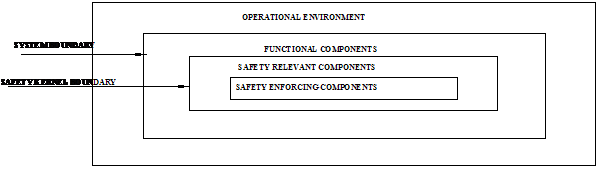
Fig.3: Component Layers.
System organization
Definitions of §3.1 match exactly
the safety kernel concept. The system is organized in three layers of
components:
·
Safety enforcing components ensure that
system properties are verified if correctness properties are verified for these
safety components,
·
Safety relevant components are
interface components, which ensure inputs of the safety kernel are independent
from functional components,
·
Functional components ensure
functionality of the system is performed.
Following this organization, control commands are of two kinds: functional commands which are set and controlled by the functional components, safety kernel commands, set and controlled by the safety components.
System analysis activities consist in identifying different
component layers and basics principles for each layer.
System behavior
States space of the system may be split in sub-spaces:
·
Nominal states are safe states where
transitions are due to environment interactions and functional commands.
·
Hazardous states are safe states
considering safety kernel commands :
If
we consider functional commands and environment interactions only, an undesired
event R could occur, which means the system should enter a dangerous state,
considering safety kernel commands, the system always enters a passive safe
state in a bounded amount of time: Always (not( R)).
·
Passive safe states.
·
Dangerous states where an undesired
event can occur or not: POT(R) or
POT(not (R)).
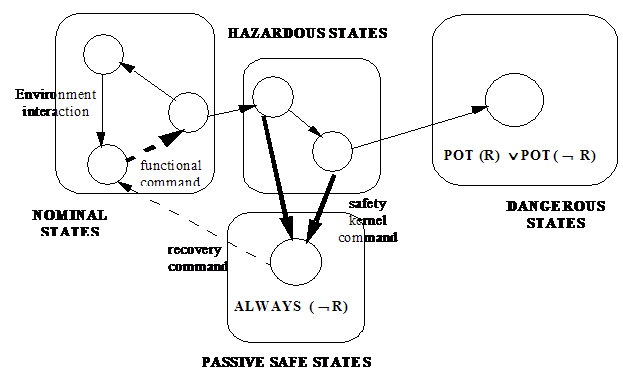 Fig.4: States space of the system S.
Safety based on the kernel design
For such architecture based on a safety kernel, the safety
demonstration consists in the twofold demonstration goals:
·
Each time the system enters a hazardous
state, the control system (the safety kernel indeed) applies a safety kernel
command, so that the system enters a passive safe state within a bounded amount
of time.
·
All hazardous states are detected.
Practically, the problem is to specify components properties
so that:
Let XH(t)
be a hazardous state, entered at time t, always (XH(t) > is a
passive safe state)
<=>
(" t Î TIME, $ a
safety command and a time amount t, XH (t) => X(t+t) is a passive safe state).
Timing constraints t depend on operational
constraints and their specification is a part of safety analysis.
3. Case Study
3.1. Case Study description and objectives
This approach has been applied to collision risk in the
context of a subway ground transportation system: MAGGALY ([MAIRE 93]). This
system is a fully automated subway system. In this section, the risk, which is
considered, is only the side collision between two trains.
We chose this example for the following reasons:
·
It implies software, fail safe hardware
and software parameters, so that we can point out various safety components in
the kernel.
·
It is quite simple.
3.2. System breakdown
The whole ground transportation system in its environment is
composed of the following subsystems:
Rolling stock.
This subsystem performs functions according to dynamic and cinematic on one
hand and according to commands set by the control/monitoring system.
Control and
Communication. It is broken down in two functional subsystems: one is
devoted to operations control (trains description, communication with
operators, ....) and the automatic train pilot (ATP). ATP is broken down in
ground ATP and on board ATP. Finally ground functions of ATP are distributed
among the topology whilst on board functions are replicated on trains.
Vital
Signaling. This subsystem monitors trackside equipments such as points,
train detectors, tracks circuits and wayside signals. It interacts with ATP for
route setting: routes are defined at the ATP level and are set by the signaling
system.
Civil
engineering. This subsystem defines all the trackside equipments
physical implantation, the topology (distances, slopes, ...). It interacts with
ATP subsystems through parameters, called "topological parameters".
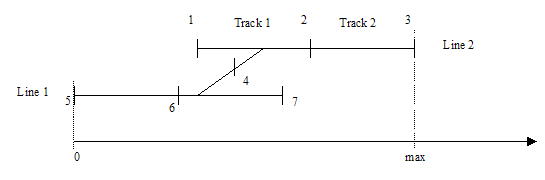
Fig.5: An
example of track topology.
Rails are split into track segments where each track segment has an unique identification. Track circuits indicate whether or not a train is standing in the corresponding track section. We model a track topology by a graph in which the nodes represent particular point and the edges represent connectivity for the train traffic.
Let POSITION be the set of all possible train positions. An
implementation of a position will be an ordered pair where the first projection
is a line identifier 1 or 2 and the second projection is a natural number
denoting a geographical position in this line. For a node n, the function pos(n) return the geographical position
of the node n, for example pos(5) =
0.
Must
be completed
A tracks tr is a position triple,
example Track 1 = (1,4,2) and Track 2 = (2, 3, nil).
We can defines an operation
pos_2_track which associate a track to any valid position.
pos_2_track : POSITION à
TRACKS
To
be define
Operators and
users may be seen as a part of the transportation system.
Interactions are managed by the Control and Communication subsystem. It is
important to take into account end users and operators, since safety properties
are related to them.
This system breakdown is a simplified one, sufficient for
our case study.
3.3. Safety properties at the system level
Points are track segments connected to more than two tracks segments (POINTS Í TRACK).
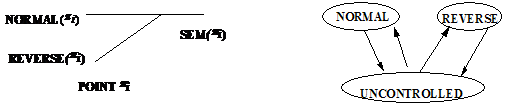
Fig.6: Static and Dynamic definition of points.
We consider the risk of "side collision", which may happen when two routes are convergent. Let pi be the point, normal(pi) and reverse(pi) are the controlled positions of point pi. We define track_support(k,t) the function which associates to any train k its occupancy on track tr at instant time t.
normal : POINTS à
POSITION
reverse :
POINTS à
POSITION
sem :
POINTS à
POSITION
track_support : (TRAIN * TIME) à
TRACKS
For a train k and an instant time t, we define the function a(k,t) which represent the geographical
position of back axle of train k on the topology at instant time t.
Formalization of side collision is the following:
" t Î TIME, " k, j Î Train,
Side_collision (k,j,t) ó
$ pi Î POINTS,
pos_2_track(normal (pi)) = track_support (k,t)
Ù pos_2_track(reverse (pi)) = track_support (j,t)
Ù pos (normal (pi)) £ a(k,t)£ pos (sem(pi))
Ù pos (reverse (pi))£ a(j,t) £ pos (sem(pi))
Ù ½ a(k,t) - a(j,t) ½ £ C(pi) (TRACK GAUGE)
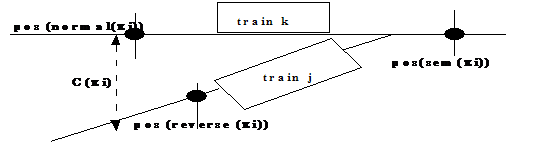
Fig.7: A side
collision
The corresponding safety property is that the event side_collision(k,j,t) does not occur or
may occur with a probability which is negligible < 10-9.
3.4. Safety properties allocation onto system components
In this step, safety properties are distributed onto
subsystem functions, so those safety kernel components are specified by their
correctness properties. Allocation is based on a derivation process, according
to system design (breakdown and principles). Once allocation is done, the whole
set of basic properties, which have been identified, must be validated in terms
of risk closure.
Restrictivity
Safety properties breakdown process relies on a "restrictivity
assumption". We assume that every subsystem Sj (or component)
has a restrictive state sj, which is supposed to be reached by Sj
in case of failure. This behavioral property is a very important constraint.
For every subsystem one must verify that:
" t ÎTIME, X(t) =
(e1, e2,....,sj,...el) where sj is a
"restrictive state" of subsystem Sj
<=>
$ command (Sk, k ¹ j) / X(t)> , tÎ[0,¥] Ù Pi is verified
i Î[1,n ]
This property means that Sj is "fail
safe". For instance if the signaling fails (whatever the failure semantic
is considered), all signals are considered to be red (not permissive) and all
points are supposed to be uncontrolled. This restrictive assumption is done by
other subsystems, which operate appropriate commands. Usually, the whole system
reaches a passive safe state, through this assumption because all subsystems
reach their respective restrictive states.
Safety properties identification and allocation
Vital Signaling
The vital signaling system implements signals, which are
used for points protection. POINTS is the set of points controlled by the Vital
Signaling subsystem. SIGNALS is the set of signals which are controlled by the
Vital Signaling Subsystem. Any signal has two states: permissive (green) or not
permissive (red). Let us introduce the function green(s,t) which returns true if the signal s at time t is green.
For one point there are three signals, called f_normal, f_reverse and f_sem. Signaling subsystem must ensure
that if the point is in normal position (resp reverse) only f_normal signal
(resp f_reverse) is permissive, or that no signal is permissive. The state
where all signals are red is a passive safe state for signaling.
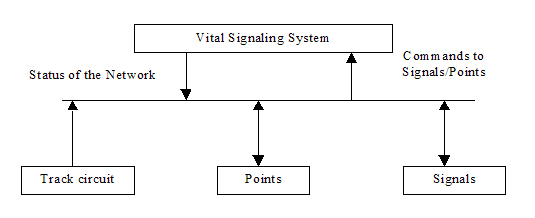
Fig.8: Architecture
of Signaling Control.
At any time t and for all track circuit tr, (tr Î TRACK). free(tr,t) is a
boolean function which indicates if a train is detected or not, on the track
circuit tr.
The corresponding safety property is described hereafter:
" t Î TIME, " pi Î POINTS
Normal_position (pi, t) Þ Ø( green(f_normal(pi),t) Ù green (f_sem(pi), t)) Ù Ø green(f_reverse(pi), t)
Reverse_position (pi, t) Þ Ø( green(f_reverse(pi),t ) Ù green(f_sem(pi), t)) Ù Øgreen(f_normal(pi), t)
Ú ( Øgreen(f_normal(pi),t) Ù Øgreen(f_reverse(pi),t) Ù Øgreen(f_sem(pi),t))
" t Î TIME, " pi Î POINTS, s Î{ f_reverse(pi), f_sem(pi), f_normal(pi)}
green(s,t)
= True => $ s Î TIME, " t’ Î [t-s , t] | green(s,t’) = False Ù free(pi,t’) = True
Civil Engineering
Signals are implemented in such a spacial position, that side collision is impossible if the spacial positions of trains are in respect with signals:
" t Î TIME , " k, j Î TRAINS, " pi Î POINTS,
a(k,t) £ pos (f_normal(pi)) Ú a(j,t) £ pos (f_reverse(pi)) Þ Ø (side_collision (k,j))
Ground ATP
Few functions are necessary for this case study. In the
following, we describe only the properties, which must be satisfied by these
functions.
Ground localisation
Train localization is performed by ground ATP. At any time t
and for any train k, train localization function computes E_ground(loc(k,t)) and E_ground(direction(k,t)). Properties of this
function are localization freshness and alarm setting if the localization
cannot be computed.
" k Î TRAIN, " t Î TIME,
E_ground ( loc (k, t) ) = nil => Alarm_localisation(t) = true
Next function
Trains relative positions are also managed by ground ATP.
Let's note Next the function which
associates to train k, the identity of the nearest train in a given direction:
Next : (TRAIN, DIRECTION, TIME) -> TRAIN
" t ÎTIME, " k Î TRAIN,
s = E_ground(direction(k,t)), Next (k,s,t) = n, Ø$ j Î TRAIN | (n ¹ j) Ù (a(k,t) < a(j,t) < a(n,t),t))
Target function
Third function is the
target function, which associates to any train k, at each time t, the
maximal position that can be reached by the train. This position depends on
trains position (Next function), signals states (permissive or not), obstacles
existence.
" t ÎTIME, " k Î TRAIN , Target (k,t) < Min { |a(x,t) - a(k,t)| }
x Î Next (k, E_ground(direction(k,t)),t)
On board ATP
We have identified two safety functions and related
properties useful for side collision avoidance: the first one is the train
localization loc(k,t) and the second one is the speed control function.
Properties are the following: for the localization function, either the
localization is fresh and precise enough or the emergency braking command is
set; the speed control safety function monitors the acceleration control
variable g,
ensuring that the target cannot be passed or that the emergency braking command
is set.
Localization function
" t ÎTIME , "k Î TRAIN,
loc (k,t) =>
{
½ E_board (a(k,t)) - a(k,t)½£ ea
Ù ½ E_board (speed(k,t)) - speed(k,t) ½£ es
Ù ½ E_board (direction(k,t)) - direction(k,t) ½=0
}
Ú Alarm_Emergency(k,t) = true
Speed Control Function
In a system representing train speeds in miles per hour, a
sub range type SPEED = 0..Max_speed is introduced.
" t ÎTIME , "k Î TRAIN,
1/2 (gt2) + speed(k,t)t < Target (k,t) - a(k,t)
Ú Alarm_Emergency(k,t) = true
where g is set by the functional ATP and |Gam_Emergency| > g.
Rolling Stock
Rolling stock applies commands set by on board ATP. In
respect of collision avoidance the only one function is speed application. The
safety property to be specified by Rolling stock is:
" t ÎTIME , "k Î TRAIN,
Alarm_Emergency (k,t)
=> $ tÎTIME | speed (k, t+t) =0
Interfaces properties
These are directly derived from the restrictivity
assumption.
Vital Signaling
Vital signaling
is a fail safe subsystem which ensures that points positions and signals
physical states are always compatible.
Degraded states are managed as follows:
·
If the control position is not known
(or not fresh enough), it is supposed to be uncontrolled,
·
When a signal fails its physical state
is set to "not permissive state" (red).
Civil Engineering
Topological parameters must be correct, that is compliant
with geographical implementation and with safety analysis.
ATP subsystem
For the ATP subsystem (both ground and on board components),
we have identified the following set of properties:
·
If a train k is near a point area, and
if a point is uncontrolled in this area, target
(k) < points control position.
·
If the location of a train is not
known, (e.g. message is not received or is incorrect), ground ATP sets E_ground (loc(k,t)) to nil value.
·
If target(k,t)
is not known (e.g. message is not received or not correct), on board ATP sets
it to nil value.
Timing constraints
They are part of safety properties. End to end properties specify the elapsed time between the occurrence of an event and the entrance into a safe state.
Risk closure
Safety properties must be validated, using semi formal or
formal methods. The demonstration relies on complementary techniques:
·
Logical trees in order to state the
demonstration scheme; in particular goals and sub-goals must be identified, at
least informally.
·
States diagrams and behavioral
properties analysis (temporal logic, liveness, timing constraints).
·
Formal proof.
Hereafter is the framework of the demonstration. The root
property is broken down in a logical combination of properties. But the formal
description of properties and the actual demonstration of risk closure are in
progress. The statement to be demonstrated is "For a given point pi,
and for any instant time there can be only one train on the track_support which contains the
point".
From Civil Engineering properties, signals implementations
are compliant with points positions and trains gauge constraints. Signals
implementations ensure that if trains are behind the signals, there is no
collision between them. This is a static property. From Vital Signaling
property, we can say that at most one signal is permissive so that only one
train can enter the point area. While the permissive signal remains permissive,
other signals are not permissive.
ATP estimates the localization of train, its direction, and
ground ATP asks for routes using pointpi. We can
suppose two trains ask for convergent routes, since vital signaling ensures only
one route may be opened. If the localization of a train is not fresh enough,
the train is supposed to be lost and all trains are stopped in a bounded amount
of time.
If trains are localized at time t, targets are allocated to trains (in a bounded amount of time) and these targets are compliant with signals physical states (states as known at time t). So that, either trains are all stopped or only one train has a target beyond the permissive signal in the point area, which is considered. Other trains targets are in respect of red signals. Any train which is localized at time t is controlled so that the target cannot be overtaken (speed control function). This implies that trains movements are compliant with targets. So that only one train enters the point area.
4. Formal Process for safety critical systems
In this paper, we address two questions:
·
It is possible to design a system so
that the safety property demonstration is traceable throughout the whole design
process?
·
To which extent can formal methods (model
checking, formal proof) be applied for the safety property verification in the
context of large and complex systems?
Our approach is exploratory and, since our work is still
going on, we have only partial results. Nevertheless, we pointed out that it is
possible to design a system so that only a few components are concerned with
safety, and that only safety properties are to be proved.
The safety demonstration we propose is organized in five
steps, throughout the system design process:
·
In the system analysis stages, risks
and safety properties are identified. Passive safe states must be identified
and the system behavior is analyzed so that it is proved that all risks are
covered by the safety properties and related passive safe states.
·
Safety properties are allocated onto
subsystems, and components according to design principles. In this step we have
to prove that system safety properties are implied by subsystems properties and
by interface properties. Interface properties rely on restrictivity assumption.
·
Third step is the formal specification
of the safety functions for each subsystem. It defines safety components. This
step is validated if safety properties are implied by safety functions
correctness.
·
Fourth step demonstrates that the
safety functions properties remain true for all environment operations and in
case of failures.
·
Fifth step is the implementation of the
safety functions. Safety component development relies on various "safety
technologies": formal methods for software fail safe technologies for
hardware.
Our case study will focus on ATP subsystem specification and
verification, for side collision avoidance. In practice, our future work will
cover steps 2 to 4 of the process:
·
Formal description and verification of
the safety properties identified in section 3.
" Pi, Ù P(Sj) Þ Pi
Sj Subsystem
In particular,
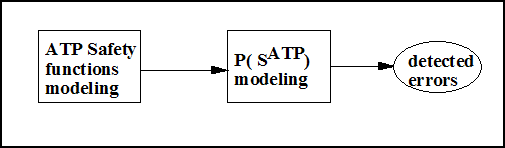
we shall identify P(SATP), the set of
safety properties to be satisfied by the ATP subsystem,
·
Formal specification of the subsystem
ATP. The related verification activity is to demonstrate that formal
specification properties => P(SATP). Whatever the modeling technique,
which will be use, the safety properties must be included in the model so that
verification or proof can evaluate safety properties.
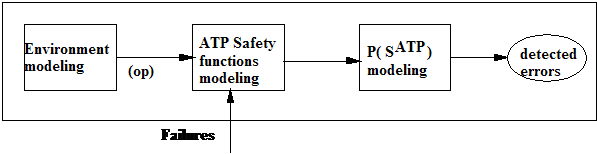
· In the
fourth step of the process, we shall demonstrate that ATP is a kernel. We shall
take into account environment operations (degraded modes for instance) and
failures in the model.
The method describes in this paper was capable to enable a
safety evaluation of the ATP at ITSEC ([ITSEC 90] and [ITSEC 91])
assurance-correcteness level E4 (or E5 or E6) requirements.